
Powered By


Hard subject and I know there are many variables so not sure how that number is averaged or data collected. I have read many times on here that the spouse is in their 9th-10th year etc. Just curious where one might find the data and research done that came up with these averages, again I understand the many variable just looking for data and average progression levels , what some of the variables are and such…..Engineer mind so data helps me plan. Others may think…..who cares and I understand… read more
@A myALZteam Member: I'm a former Risk Manager, so I totally understand the need to digest data in order to plan for the unknown. I'm putting you on my Team. You may want to do the same, and to look at my page and prior postings because I've shared a LOT of info on this site.
That said, I think you need to REALLY grasp the Stages and to know where your wife is now. No one will know that better than you, but if this is your first time thinking about what Stage she's at, it may require some thoughtful observation.
I'm going to give you a link to information I've previously posted, and ask that you click on the link and please read all of the comments because the discussion will become enlightening. Please let me know when you have done that, and I will then give you one more chart.
https://www.myalzteam.com/questions/66195c8a566...

@A myALZteam Member: I'm going to add one more note. It's important to understand and be mindful of the Stages because the patient qualifies for Hospice Care at Stage 7C (Can no longer walk), which can bring a lot of help, if you're going through all of this at home.
Very helpful and yes I embrace the variables just like planning for the worse and hoping for the best.
Still In progress : Saved before reboot of unstable laptop
FAST SCALE perhaps sharper copy. @A myALZteam Member and @A myALZteam Member
As Helen already mentioned, the first scale she posted to George is not for the fainthearted, as it links stages to expected duration, and hence life expectancy. I have done a little more digging, and here is a very interesting set of publications destined for use by medical professionals. The copy of the table below is from "Assessing Patients on the FAST Scale: A Guide for Nurses" By Peter Abraham, BSN, RN, Published on May 20, 2024, Updated on July 29, 2025" Reference below. It is on my computer, when viewed side by side, slightly sharper than Helen's posted version. However the original is a little unsharp as well, so probably comes from some earlier presentation, as yet unknown to me.
Here follow some more useful references to put the whole story in perspective. The FAST scale was developed by Dr Reisberg and published in 1985, a reference in the Medical News Today article referenced below. An overwhelmingly rich collection of information on palliative care and hospice services and criteria is in "Core Screening Tools to Identify and Care for Individuals that may Benefit from Palliative Care" see the allianceforcareathome reference below.
https://compassioncrossing.info/assessing-patie...
https://www.medicalnewstoday.com/articles/fast-...
https://allianceforcareathome.org/wp-content/up...
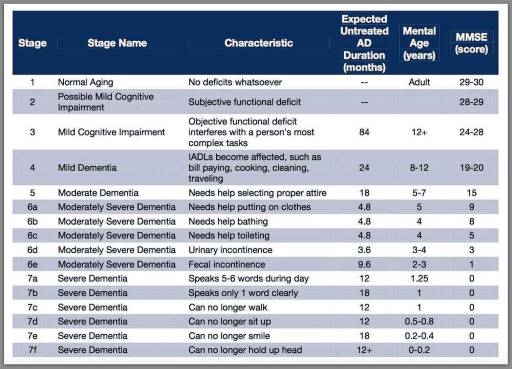
@A myALZteam Member I agree with @A myALZteam Member ‘s insistence on knowing where, in what stage your wife is. Helen and I are thinking buddies (her words) and (used to ?!) post frequently here. Your question has been asked before, and it’s become clear to me there are no precise figures possible. (1) Ultimately Only God knows the number of our days ;(2) It varies across the main kinds of dementia; (3) add to that the often occurring combinations [my wife, for example, has a mixture of Alzheimer’s and Lewy Body disease] with different survival curves; The stages (see Helen’s multiple posts) are in my opinion constructed as generalisations of particular interest to carers, without any clear way to fine-tune survival expectancies according to a precise diagnosis. The AI generated answer given by myALZteam gives life expectancies for a series of ages at diagnosis. But these are also imprecise. Meta analysis papers always discus the many confounders that broaden the confidence intervals.
George, It’s nice to find an engineer here, I myself am a PhD scientist (retired) with some 40 years industrial experience (read my Story). If you want to exchange any further thoughts, I am happy to oblige, neuroscience has become a new specialisation for me!


 Continue with Facebook
Continue with Email
Continue with Facebook
Continue with Email

 Join
Join



 Your Privacy Choices